
Axis Bank Ltd
Axis Bank Fundamental and Technical Analysis
STOCK ANALYSIS
Harsh Garg
12/19/20255 min read
About Company
Axis Bank is India's third-largest private sector bank by assets, headquartered in Mumbai and offering a wide range of financial services to retail, corporate, SME, and agricultural customers. Originally launched as UTI Bank in 1994, it rebranded to Axis Bank in 2007.
Business Segments
Axis Bank operates across several key business segments tailored to diverse customer needs in India. Its primary segments include Retail Banking, which serves individual customers with products like savings accounts, personal loans, home loans, credit cards, and deposits; Wholesale Banking, focusing on large and mid-sized corporates through working capital finance, term loans, trade finance, and cash management; and Commercial Banking, targeting SMEs and mid-corporates with solutions such as business loans, loans against property, and supply chain financing. The bank also emphasizes Rural and Agri Banking to support farmers and rural enterprises via crop loans, gold loans, and farm mechanization financing, alongside strong digital platforms like 'open' and 'neo' that enhance payments, wealth management, and transaction banking across all segments. These segments contribute to a diversified loan book, with retail at around 60%, SME and mid-corporate at 23%, and corporate at 29% as of recent reports.
Company Branches and Offices
Axis Bank maintains an extensive domestic network with 5,876 branches and 13,941 ATMs and cash recyclers across India as of March 31, 2025, where nearly 47% of branches are located in rural and semi-urban regions to enhance financial inclusion. These branches span all states and union territories, supporting services from retail banking to corporate lending, with key concentrations in urban hubs like Mumbai, Delhi, and Bengaluru, alongside rural outreach for agriculture and SMEs. Internationally, the bank operates eight offices, including full branches in Singapore, Dubai (DIFC), and GIFT City-IBU, plus representative offices in Dhaka, Dubai, Abu Dhabi, and Sharjah, focusing on trade finance, syndication, and wealth management for global clients.
Future Plans
Axis Bank outlines ambitious plans centered on customer-centric innovation, digital transformation, and sustainable growth to build a resilient, future-ready institution. The bank aims to expand its branch network, deepen retail and wholesale banking through premiumisation and product innovation, and scale digital platforms like UPI 2.0, Gold on UPI, and CBDC pilots while enhancing deposit mobilization via salary credits and high-RAROC businesses. Strategic priorities include bolstering ESG-aligned sustainable finance, supporting national goals in infrastructure and exports under 'China +1', and leveraging regulatory easing for sectors like real estate, SMEs, and global capability centers, with a focus on disciplined cost management and asset quality. Through initiatives like Moves 2025, Axis Bank plans to engage young talent for banking innovation and foster collaborations for inclusive progress, projecting strong profitability amid India's projected 7-7.5% GDP growth in FY26-FY27.
Financial Prospects of the Company
The market capitalization is 3,82,024 crores
The stock price is 1,231
The price-to-earnings (PE) ratio is 14.7
The book value (PB) is 639
The price to book value (PB x PE) is 28.4
The return on equity (ROE) is 16.3%
The return on capital employed (ROCE) is 17.11%
The annual dividend yield is 0.08%
The company has the cash equivalents of 63,843 crores
The company's sales and profits in the last 5 years
In FY 2020-21, sales were 64,397 crores and profits were 7,252 crores. In FY 2021-22, sales were 68,846 crores and profits were 14,207 crores. In FY 2022-23, sales were 87,448 crores and profits were 10,919 crores. In FY 2023-24, sales were 1,12,759 crores and profits were 26,492 crores. In FY 2024-25, sales were 1,27,347 crores and profits were 28,191 crores.
The company's sales and profit growth in the last 5 years
Over the last 5 years, sales growth was 14.9% and profit growth was 72.2%. In the last 3 years, sales growth was 22.8% and profit growth was 25.7%. In the last 1 year, sales growth was 6.09% and profit grwoth was -6.94%.
Shareholding Pattern
The promoter holds 8.16%, FIIs hold 41.89%, DIIs hold 42.87%, Public holds 7.06%
Company News
Management highlighted easing stress in retail portfolios, particularly credit cards and personal loans, alongside stabilizing personal loan books and no visible distress in export-oriented MSMEs. Corporate demand is gaining momentum through stronger working capital utilization and refinancing, while retail recovery shows pent-up demand, though its sustainability requires monitoring. Q2 FY26 results showed a 26% YoY drop in standalone net profit to Rs 5,090 crore, despite a 2% rise in net interest income to Rs 13,744 crore.
In other developments, Axis Bank plans to raise up to Rs 5,000 crore via Series-9 NCDs on private placement, part of a broader Rs 35,000 crore debt fundraising strategy to fuel growth. The bank also committed over Rs 80 crore to Plaksha University for a FutureTech building to advance deep-tech research, underscoring its focus on innovation amid market challenges. Year-to-date, the stock remains up 16-18%, outperforming the Sensex, with proximity to its 52-week high of Rs 1,304.
Technical Analysis
Company Chart

Moving Average (MA)
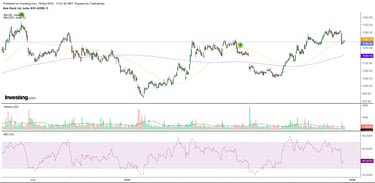
The stock is trading just under the 50-MA, which indicates the stock is in a short-term price correction.
The stock is trading above the 200-MA, which indicates the stock is in a bullish trend for the long-term.
Relative Strength Index (RSI)
The RSI of the stock is 41, which indicates that the stock is neither in the oversold nor in the overbought zone.
Chart Patterns
The chart patterns show the strong long-term growth.
Strengths and Weaknesses of the Company
Strengths
Extensive branch and ATM network exceeding 5,800 branches and 13,000 ATMs, with strong urban presence and growing rural penetration.
Advanced digital banking capabilities, including AI-driven mobile apps with over 50 million downloads and 75% of transactions digital, enhancing customer convenience.
Robust financial performance, with high revenue (Rs 18,680 crore in Dec 2024), consistent profitability growth, and a solid capital adequacy ratio of 16.8%.
Diversified product portfolio spanning retail, corporate, SME, and wealth management services, supported by strong brand equity.
Weaknesses
Elevated non-performing assets (NPAs) in retail segments like personal loans and credit cards, impacting profitability and asset quality.
High operational costs from maintaining a vast physical network, leading to lower cost-efficiency compared to digital-first competitors.
Customer service challenges, including slow grievance resolution and complaints about hidden charges, as noted in online reviews.
Overreliance on interest income and corporate lending exposes the bank to economic downturns and NIM pressures.
Analysis
Axis Bank stock trades around Rs 1,230-1,250 as of December 2025, down 4% recently due to Citi's neutral rating, citing NIM pressure until Q4 FY26. It shows strength with 16-18% YTD gains,a solid 16.8% capital ratio, and retail loan growth, but faces risks from high NPAs in personal loans and slowing profits. Analysts see moderate upside to Rs 1,285 with improving corporate demand and digital push, making it a hold for long-term investors amid India's 7% GDP outlook.
Follow us on


Smart Money Management is a finance platform dedicated to helping people make smarter decisions about earning, investing, and managing money.
Quick Links
Contact Us

smm@smartmoneymanagement.site
© 2026 Smart Money Management. All Rights Reserved