
Dixon Technologies (India) Ltd.
Fundamental and Technical Analysis of Dixon Technologies
STOCK ANALYSIS
Harsh Garg
1/21/20266 min read
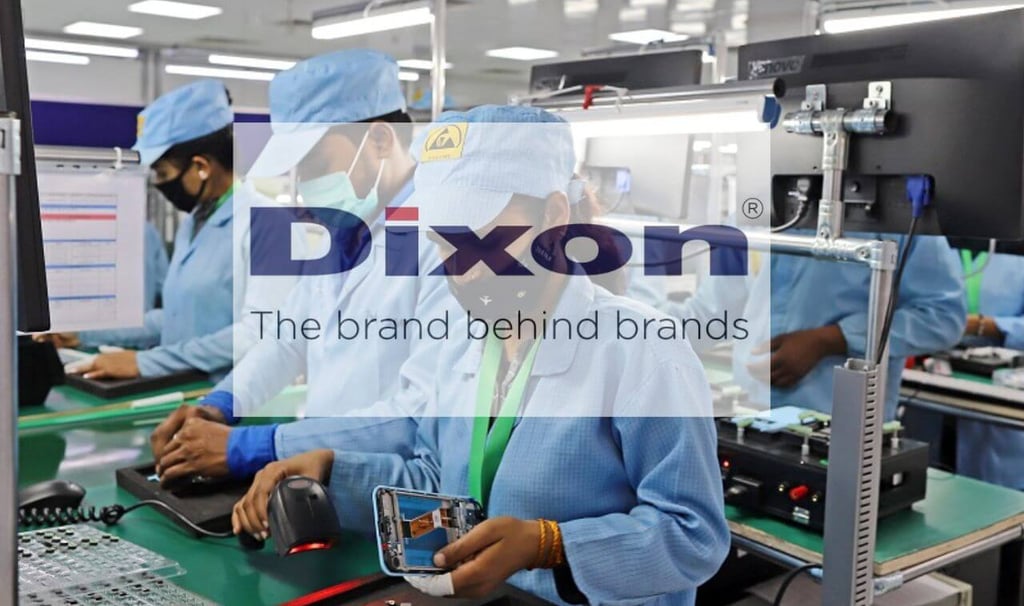
About Company
Dixon Technologies (India) Limited is a leading Indian electronics manufacturing services (EMS) company headquartered in Noida, Uttar Pradesh. Founded in 1993 by Sunil Vachani, it began with CRT television production and has grown into India's largest EMS provider.
Business Segments
The company operates in various important business categories within the electronics manufacturing services (EMS) sector, with the Mobile & EMS division contributing around 84% of revenue in recent times. This section manufactures mobile phones, hearables, wearables, IT hardware such as laptops and servers, and telecom goods for companies including Xiaomi, Motorola, and Oppo. Other divisions include Consumer Electronics (mainly LED TVs and refrigerators), Home Appliances (washing machines using a fully ODM approach), and Lighting Products (LED bulbs, tubelights, and drivers), as well as minor fields such as CCTV, DVRs, and security systems. The company's diverse portfolio provides end-to-end solutions ranging from design and assembly to logistics, which aligns with India's manufacturing push.
Company's Facilities
The companyoperates around 17-24 advanced manufacturing facilities across India, supporting its diverse electronics production needs. Key locations include its headquarters and major plants in Noida and nearby areas like Sector-63, Sector-80, Ghaziabad, and B-18 in Uttar Pradesh for smartphones, lighting, and consumer electronics; Dehradun in Uttarakhand for LED lighting and washing machines; Tirupati and Sri City in Andhra Pradesh for mobiles, wearables, and feature phones; Hyderabad in Telangana for set-top boxes; Pune in Maharashtra for home appliances; Chennai and the new Sriperumbudur facility in Tamil Nadu for LED TVs and laptops; Baddi in Himachal Pradesh for lighting and durables; Bhiwandi; and Ludhiana in Punjab for telecom products. These state-of-the-art plants feature automation, quality labs, and sustainable practices, enabling high-volume output for global brands while aligning with India's manufacturing initiatives.
Production Capacity
The company has significant manufacturing capacities throughout its core divisions, which support its position as India's leading EMS provider. Mobile phone manufacturing currently stands at roughly 50 million smartphones and 40 million feature phones per year, with ambitions to increase to 55-65 million units by FY26, including 40-42 million from recent expansions and joint ventures such as Longcheer. IT hardware capacity aims to produce 1.5 million laptops through new facilities, as well as 24 million display modules for smartphones and 2 million for notebooks, with a potential increase to 60 million smartphone displays. Other fields include LED TVs (the biggest plant in Tirupati), washing machines (Dehradun with 12 lakh units, increasing to 25 lakh), refrigerators (17 lakh units), and lighting items from Noida facilities. These capacities correspond to an investment of Rs 1,100-1,150 crore in FY26, enabling export growth and "Make in India" volumes for clients such as Motorola, Xiaomi, and Oppo.
Future Plans
The company's ambitious expansion ambitions are matched with India's growing electronics manufacturing environment, with considerable capacity increases and new product lines expected by 2026-2027. The company plans to increase mobile phone production from 25-30 million units today to 40-45 million by FY26 and 60-65 million by FY27, with new clients including Vivo, Nothing, and Intel joining old partners such as Samsung, Xiaomi, and Motorola. Key initiatives include a joint venture with HKC for a Noida facility producing 20 million mobile displays initially (doubling to 40 million in year two, generating ₹2,500 crore revenue), a new laptop plant with 1.5 million unit capacity operational by Q4 FY25, and ramps in display/camera modules, telecom products through Airtel JV, refrigerators, and IT hardware. Dixon expects 50% revenue growth in FY26, a fourfold increase in the mobile and EMS market to ₹480 billion in 5-6 years, and contributions to the industry's $300 billion ambition by 2026-27.
Financial Prospects of the Company
The market capitalization is 63,822 crores
The stock price is 10,517
The price-to-earnings (PE) ratio is 49.3
The book value (PB) is 672
The price to book value (PB x PE) is 772
The return on equity (ROE) is 32.8%
The return on capital employed (ROCE) is 40.0%
The annual dividend yield is 0.07%
The company has the cash equivalents of 643 crores
The company's sales and profits in the last 5 years
In FY2020-21, sales were 6,448 crores and profits were 160 crores.
In FY2021-22, sales were 10,697 crores and profits were 190 crores.
In FY2022-23, sales were 12,192 crores and profits were 255 crores.
In FY2023-24, sales were 17,691 crores and profits were 375 crores.
In FY2024-25, sales were 38,860 crores and profits were 1,233 crores.
The company's sales and profit growth in the last 5 years
Over the last 5 years, sales growth were 54.6%, and profit growth were 45.0%.
Over the last 3 years, sales growth were 53.7%, and profit growth were 59.7%.
Over the last 1 year, sales growth was 75.6%, and profit growth was 131%.
Investors
Shareholding Patterns
Promoters holds 28.83%
FIIs holds 18.68%
DIIs holds 29.06%
Public holds 23.43%
Company's News
The company's shares have dropped by 40% in the last four months, reaching a 2024 low of roughly ₹10,500 on January 20. Brokerages such as Nomura, Emkay Global, and Investec maintained 'Buy' ratings but reduced target prices to ₹15,000-16,598, citing delays in government approvals for key joint ventures with Vivo and HKC, rising global memory prices impacting mobile production, Xiaomi market share loss, and softer consumer demand.
Key issues include a 27% fall in FY26 smartphone volume expectations to 32 million units (excluding Samsung), down from previous projections, as well as 19-13% EPS reductions through FY28 due to the headwinds. Management anticipates PLI 3.0 approvals in early 2026, which could unleash income from display modules and higher-margin categories.
Despite near-term difficulties, analysts emphasize long-term opportunities: ramps in IT hardware (HP, Lenovo laptops), telecom (Airtel JV, microwave radios), backward integration in camera modules, and server, PCBA, and automotive displays. Emkay sees the selloff as excessive, expecting a 50% volume CAGR through FY28 with 30%+ return ratios, aided by new ODM clients such as Oppo and Motorola exports.
Technical Analysis
Company Chart

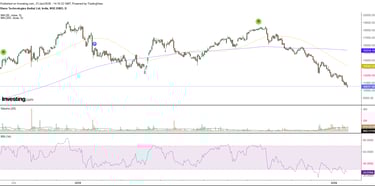
Moving Average
The stock is trading under the 50-MA, which indicates that the stock is in a bearish trend.
The stock is also trading under the 200-MA, which indicates that the stock is bearish trend for some more time.
Relative Strength Index (RSI)
The RSI of the stock is 24, which is a strong sign that the stock is in an oversold zone.
Chart Patterns
The stock price has come down to its 2024 levels. Stock is likely to bounce back if the market conditions get better.
Strengths and Weaknesses of the Company
Strengths
Leads India's EMS sector with varied sales from mobiles (84% share), IT hardware, telecom, consumer electronics, appliances, and lights, resulting in 120% FY25 growth and a 53% increase in H1 FY26.
Strong customer ties with Xiaomi, Samsung, Motorola, HP, Lenovo, Airtel, and new arrivals such as Vivo, Oppo, and Realme; PLI program beneficiaries in five segments with thresholds fulfilled.
Exceptional execution: short 6-day working capital cycle, ROCE ~40%, 55% five-year sales CAGR, low debt (interest coverage 14.3x), and quick capacity ramps through JVs like HKC displays.
Export growth in Africa/Latin America (₹7,000cr+ FY26) and backward integration in modules will increase margins and competitiveness.
Weaknesses
The company's heavy reliance on the mobile/EMS market exposes it to smartphone volume reduction (FY26 forecasts are down 27% to 32 million units), Xiaomi share loss, and global memory price increases.
Contract manufacturing (OPM reducing to 3.5–3.7%), working capital intensity, and client incentive sharing under PLI schemes all put pressure on margins.
Regulatory delays in PLI 3.0 clearances for Vivo/HKC joint ventures, combined with sector headwinds such as lower demand and competitiveness, eroded stock value by 40% recently.
The pure-play EMS has little pricing power, with the promoter holding at 28.9% and a high P/E of ~50x, notwithstanding negative options activity.
Analysis
Dixon Technologies stock is currently trading at roughly ₹10,530, down 1.4% today and 37% over the past year. It reached a 52-week low of ₹10,274 due to industry challenges. The high P/E of 41x reflects great previous performance (120% FY25 revenue surge, 53% H1 FY26), but confronts near-term threats such as memory chip price hikes, delayed PLI clearances, Xiaomi volume cutbacks, and Motorola reductions. Brokerages have trimmed FY26-28 EPS projections by 13-27% and targets to ₹15,000. The long-term outlook remains good, with most analysts recommending a 'Buy' (26/34), owing to IT hardware ramps, new joint ventures, and a 50% volume CAGR potential through FY28.
Follow us on


Smart Money Management is a finance platform dedicated to helping people make smarter decisions about earning, investing, and managing money.
Quick Links
Contact Us

smm@smartmoneymanagement.site
© 2026 Smart Money Management. All Rights Reserved