
El Nino, Weak Monsoon and India: What It Means for Your Economy and Stock Market
El Nino is likely to weaken India’s 2026 monsoon, hurting farm output and pushing food prices up. This blog explains in simple words how it can slow GDP growth, make RBI cautious on interest rates, and change which stock sectors will win or lose
MARKET NEWS
Harsh Garg
6/18/20264 min read
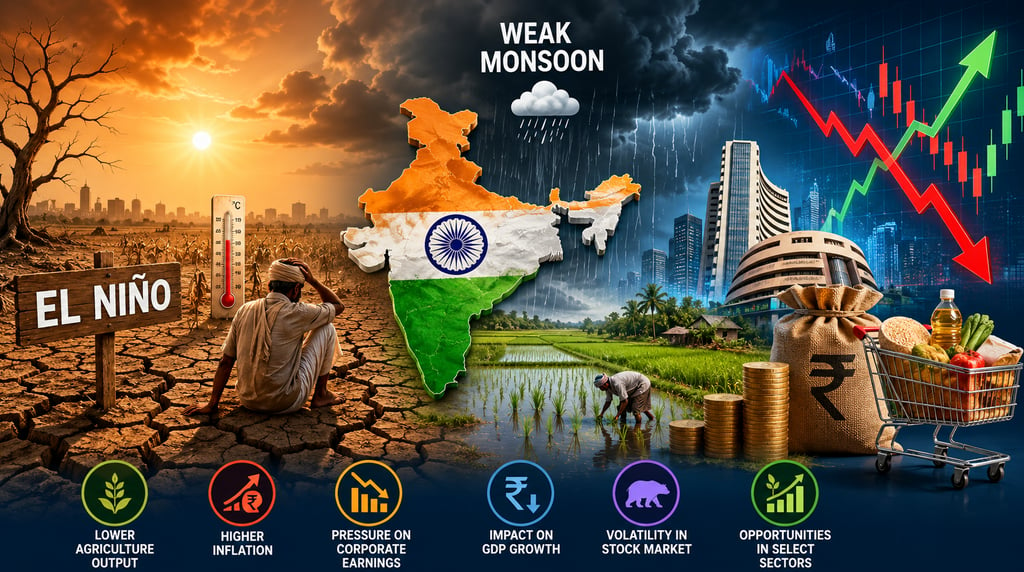
El Nino is a weather condition that warms Pacific ocean water and typically results in less rain in India. The India Meteorological Department (IMD) has predicted that the monsoon in 2026 will be below average, at roughly 90% of the long-term average, and that August and September will likely be very dry. A weak monsoon can reduce farm output, increase food costs, and stall growth because agriculture and rural life depends so heavily on these rains. In summary, El Nino makes the stock market more cautious and poses a serious risk to India's economy.
What El Neno is Why it Weakens the Indian Monsoon?
El Nino refers to warmer-than-normal sea temperatures in the Pacific Ocean close to the equator.
Weaker and more unpredictable southwest monsoon rains result from this warmth's altered wind patterns and decreased moisture movement into India.
India frequently experiences below-average rainfall, hotter summers, and occasionally drought-like conditions during strong El Nino years.
Impact on India's Economy
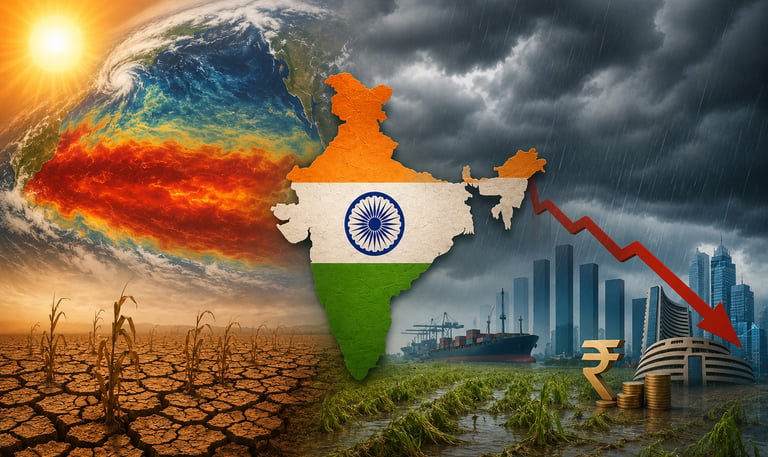
Agriculture and farm output will be negatively affected
Nearly half of India's agricultural land is directly dependent on summer rainfall, and over 60% of rural laborers work in agriculture.
Rice, pulses (such as arhar and moong), oilseeds (such as soybean and peanut), cotton, and coarse cereals (such as maize and bajra) are important Kharif crops that are at risk.
Strong El Nino episodes can reduce the country's rice production by an average of 3.4 million tons, according to historical data.
Lower crop yields result in lower farm revenue, which lowers spending on FMCG, two-wheelers, and other products that are in high demand in rural areas.
Food Prices can Significantly Rise
Rice, legumes, vegetables, and oil prices rise worldwide due to food shortages.
A significant agricultural disruption might increase CPI food inflation by roughly 0.4%, according to ICRA.
In an extreme case, some economists caution that food inflation might increase by 8–12% from baseline, bringing headline inflation closer to or beyond 6%.
This raises the possibility of "stagflation" (slow growth plus high inflation) and is higher than the RBI's 4% aim.
GDP Growth can be Slower Down
A farm shock immediately lowers overall growth because agriculture accounts for about 18% of India's GDP.
According to DBS, a severe monsoon deficit might lower agriculture GVA growth from 3.5% to 2%, resulting in a 20–30 basis point drop in headline GDP.
In the worst case, GDP growth might decrease by as much as 65 basis points.
Additionally, lower rural income lowers demand for produced items, which indirectly impacts services and manufacturing.
RBI policy may become more cautious
The RBI is more hesitant to lower interest rates due to high food inflation.
If inflation continues to exceed the target, the RBI may hike the repo rate or maintain higher rates for a longer period of time.
Investment and consumption may be slowed by higher rates since they might make borrowing more expensive for companies and owners of homes and cars.
Water, Power & Energy cost
Weak monsoons decrease the amount of water stored in reservoirs and the production of hydroelectric power.
Increased reliance on coal-based power due to less hydropower may result in higher electricity costs for businesses.
All things considered, drought-like circumstances may result in power outages and increased energy costs.
Rural demand and broad consumption
Spending on necessities and non-essentials is decreased in rural areas due to lower farm revenue.
Sales may be slow in industries that rely heavily on rural demand, such as consumer electronics, FMCG, tractors, and two-wheelers.
Earnings for businesses with a large exposure to rural areas may suffer as a result.
Impact on the Indian stock market
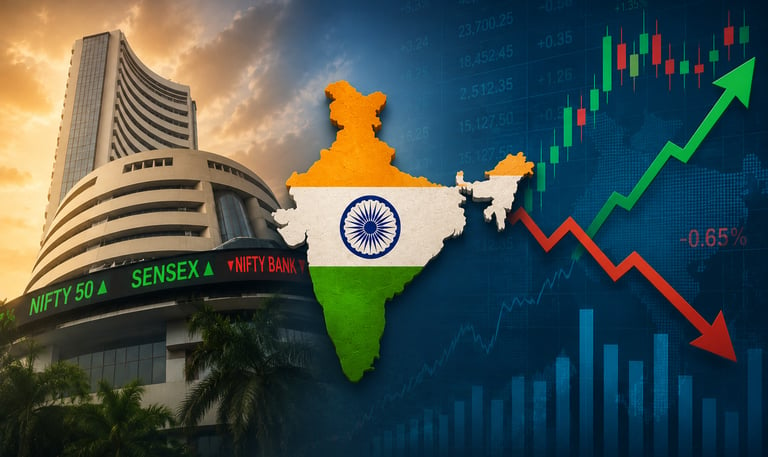
Overall market sentiments becomes cautious
El Nino years have historically been associated with increased food inflation, less agricultural productivity, less rainfall, and stress in rural areas.
Negative market mood on Dalal Street and modest GDP growth are usually the results of these events.
Even if the market would not crash, lower revenues in industries that deal with rural areas and increased inflation risk could limit gains.
Sectors that may slow down
Industries reliant on agriculture: Businesses that depend on crop yields, fertilizers, and agri-inputs may experience reduced production or price pressure.
FMCG and consumer goods with exposure to rural areas: A lot of FMCG companies have significant sales in rural areas, and lower demand can negatively impact profits.
Tractors and two-wheelers are traditional rural-demand items; decreasing farm income may result in lower sales.
Food processing: If businesses don't pass expenses on to customers, higher input costs (pulses, oil, and vegetables) may put pressure on margins.
Water-intensive industries and hydro power: Lower reservoir levels may result in lower hydro output and higher expenses for water-dependent companies.
Sectors that may not much affected
Power and cooling stocks: Increased demand for energy and cooling due to hotter weather and less hydro may result in higher utilization for power firms.
Thermal power and energy: Coal-based electricity may run more when there is less hydro, enabling thermal power producers.
Imported food commodity players: Certain trade and import-related companies may profit if India imports more rice, pulses, or oil as a result of domestic shortages.
Defensive industries: Pharmaceuticals, healthcare, and some IT services may perform better because they are less dependent on rural cycles.
Urban-focused businesses: Compared to their rural-heavy counterparts, businesses that primarily cater to urban customers may be less impacted by rural stress.
What investors generally do in such situation?
Investors usually invest in urban-focused companies and defensive industries.
Companies with considerable pricing power and little exposure to rural areas are preferred.
Conclusion
El Nino is expected hamper India's monsoon in 2026, which might harm agriculture, increase food prices, slow down GDP growth, and make the RBI more cautious about interest rates. In terms of the stock market, this indicates a shift toward defensive and power/energy firms, potential earnings downgrades in sectors that deal with rural areas, and more caution. The market might not fall, but until the monsoon and inflation picture becomes more apparent, returns might be modest and more unpredictable.
Follow us on


Smart Money Management is a finance platform dedicated to helping people make smarter decisions about earning, investing, and managing money.
Quick Links
Contact Us

smm@smartmoneymanagement.site
© 2026 Smart Money Management. All Rights Reserved