
Global Tensions are Rising: What's the Future of Indian Markets?
Global tensions from wars and trade fights are hitting India's stocks short-term, with Nifty down 3% early in 2026 on FII selling and oil spikes.
MARKET NEWS
Harsh Garg
1/25/20262 min read
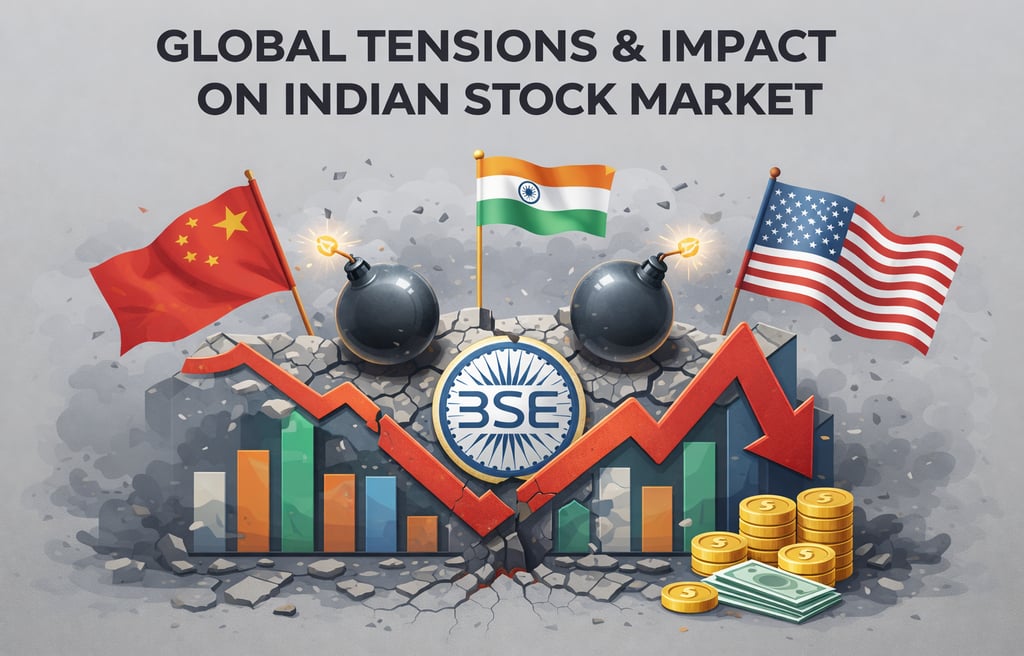
Global concerns, including increasing conflicts in Ukraine and the Middle East, as well as potential US-China clashes over Taiwan, are generating short-term volatility in India's financial markets. As of late January 2026, the Nifty 50 has declined almost 3% year-to-date, with FII outflows exceeding ₹32,000 crore, signaling risk aversion due to trade concerns and geopolitical risks. Despite this, experts predict a turnaround with double-digit gains by year-end, boosted by India's robust domestic economy.
Current Market Snapshot
On 23 January 2026, the Sensex closed at 81,538 points, down 0.94%, while the Nifty ended at 25,049, establishing bearish candles with supports at 24,975 and 58,250 for Bank Nifty. Markets peaked in early January (Nifty at 26,373). Still, they fell rapidly as a result of US tariff threats against Russian oil importers such as India, EU trade spats, and broader tensions involving Venezuela, Iran, and NATO-Russia confrontations. FII selling contrasts with significant DII inflows, forming a buffer against a sinking currency.
Key Global Tensions
The biggest risks for 2026 are geoeconomic confrontation (e.g., tariffs, supply chain disruptions), state-based armed confrontations (e.g., the Russia-Ukraine escalation and the Iran-Israel resurgence), and cyber threats to infrastructure. Tier I challenges identified by CFR include the China-Taiwan crisis, North Korean tests, domestic unrest in the United States, and Middle Eastern conflicts (Gaza and the West Bank). According to the World Economic Forum, 50% of experts foresee a turbulent two-year outlook, rising to 57% over 10 years, owing to decreasing multilateralism.
Impact on India
Geopolitical upheavals raise oil prices and FII outflows, as shown in January's fall caused by Middle East tensions and US trade policies, harming IT, exports, and consumer industries. Trade deal delays with the US, projected 500% tariffs on Russian oil customers, and rupee depreciation increase volatility, with midcaps down 5% and smallcaps down 8% year to date. Oil and gas companies may gain from lower crude prices if tensions lessen, but manufacturing slowdowns increase pressure.
Positive Domestic Drivers
India's economy is expected to increase by 7.3-7.4% in FY26, driven by private consumption, fixed investment, and a revival in manufacturing and services. The RBI finds hope in robust banks, GST cuts, and low inflation, with H1FY27 GDP at 6.7-6.8%. Government stimulus, such as tax cuts and rate reductions are expected to boost corporate earnings by 12-15% in FY26-27.
2026 Forecast
Base-case Kotak estimates that the Nifty would reach 29,120 by December 2026 (20x FY28 EPS), assuming policy support and 6.7%+ growth. HSBC anticipates double-digit returns from consumption resurgence and regulatory relaxation, but dangers such as protectionism remain. Long-term bulls prefer quality equities on declines, with India remaining robust as the fastest-growing major economy. Volatility may persist in the short term, but structural forces position equities to win if global uncertainties subside.
Follow us on


Smart Money Management is a finance platform dedicated to helping people make smarter decisions about earning, investing, and managing money.
Quick Links
Contact Us

smm@smartmoneymanagement.site
© 2026 Smart Money Management. All Rights Reserved