
How Monsoon Affects the Indian Economy and Stock Market
The monsoon decides how much rain falls on farms, which directly affects crop production, farmer incomes, and the money available in villages for buying food, clothes, and other goods.
MARKET NEWS
Harsh Garg
7/16/20263 min read
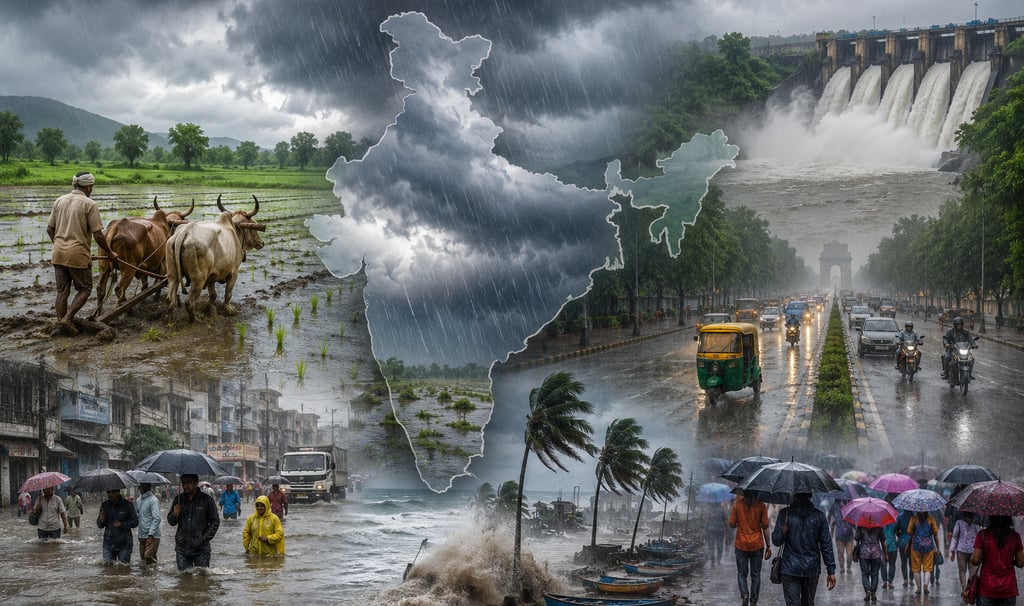
In India, the monsoon is more than just a time of rain; it is a major force behind the nation's economy and even the stock market. The amount and timing of monsoon rainfall have a direct impact on farmers, rural incomes, food prices, and eventually company profits because nearly two-thirds of India's cropland still depends on rain. The entire economy feels stronger during a good monsoon. When it is weak or uneven, a lot of issues arise.
Why does the monsoon matter so much for India?
India is still primarily a rural nation. Nearly half of the population either directly or indirectly makes their living from agriculture. A favourable monsoon indicates the following:
Crop yields are improved for farmers.
Their earnings rise
Families in rural areas have higher disposable income.
The additional funds are not retained in the fields. It spreads to stores, small businesses, and local businesses. More food, clothing, two-wheelers, home goods, and even modest assets are purchased by people. The economy as a whole benefits greatly from this increase in rural demand.
However, a weak or postponed monsoon results in the following:
Reduced yield of crops
Decreased agricultural earnings
Spending in rural areas is lower.
This may slow down growth and consumption, particularly in areas where agriculture is a major industry, such as Uttar Pradesh, Madhya Pradesh, Rajasthan, and Maharashtra.
Impact on food prices and inflation
Food costs are also influenced by monsoon rainfall. Normal rainfall results in a good supply of crops, including rice, wheat, pulses, and vegetables, as well as steady food prices. Food prices that are stable contribute to the control of overall inflation.
Food is a major component of the inflation basket in India. Therefore, overall inflation may increase rapidly if food costs increase due to a bad monsoon. The economy suffers from high inflation because
The purchasing power of people declines
To combat inflation, the Reserve Bank of India (RBI) may decide to increase interest rates.
Increased interest rates make loans more expensive and can impede the expansion of businesses.
Stock prices and market confidence may suffer if the RBI is forced to maintain high rates.
How the monsoon affects the stock market
Rain does not immediately affect the stock market. Rain has an impact on:
Incomes from farms
Consumption in rural areas
Inflation of food
Policy on interest rates
Business profits
Together, these elements have an impact on stock prices and business earnings.
Sectors that benefit from the good monsoon
Certain industries typically do well during a healthy monsoon:
Businesses involved with agriculture: Because farmers are willing to invest, businesses that sell fertiliser, seeds, irrigation, and tractors enjoy an increase in demand.
Fast-moving consumer goods, or FMCG: Spending on food, snacks, personal care, and household goods is higher among rural households. Businesses with a significant rural presence frequently find higher sales.
Two-wheelers and compact automobiles: Many rural families purchase scooters, motorbikes, or small business vehicles when they have more money.
Banks and NBFCs with an emphasis on agriculture and rural areas: When farmers borrow money for consumption, equipment, or inputs, the demand for credit rises. For banks and finance firms with an emphasis on rural areas, this can boost loan growth.
Sectors that can be hurt by the poor monsoon
If the monsoon is irregular or weak:
FMCG and two-wheeler industries suffer as rural demand declines.
Growth stocks may suffer if food inflation increases and drives up interest rates.
Sales of products that depend on agriculture, such as tractors, seeds, and fertilisers, may decline.
Particularly during a time when rural growth is already sluggish, overall market mood may turn cautious.
Is the monsoon still powerful as before
The Indian economy has evolved throughout time. The GDP share of agriculture has decreased, but industries like manufacturing, IT, and services have expanded. Therefore, there is now less of a direct correlation between monsoon rainfall and total stock market results.
However, the monsoon still has a significant impact on a number of specialised industries and businesses with a rural concentration. Analysts and investors continue to observe:
The India Meteorological Department's monsoon forecasts
Distribution of rainfall by region
Sowing progress and reservoir levels
Seasonal trends in food prices
Rainfall that is "good average" is insufficient. Distribution and timing are more important. Even if the overall amount of rainfall is normal, a delayed start or rain only in particular states can pose issues.
What should investors do
"More rain = market will always go up" is not a reliable assumption. The effect is indirect and contingent upon numerous other variables, including international markets, interest rates, and business profits.
If you want to apply monsoon trends to your ideas, concentrate on industries that are directly related to agricultural and rural demand.
Keep an eye on RBI policy and food inflation because a bad monsoon can raise interest rates and inflation, which could impact the entire market.
Recognise that markets frequently "expect" a successful monsoon before it even begins. The market could not move much if the rainfall were exactly as predicted. Stronger reactions are only produced by surprises, whether they are very pleasant or very bad.
Follow us on


Smart Money Management is a finance platform dedicated to helping people make smarter decisions about earning, investing, and managing money.
Quick Links
Contact Us

smm@smartmoneymanagement.site
© 2026 Smart Money Management. All Rights Reserved