
Middle East Conflict, Rupee Depreciation, and FII Outflow. What is the Future of Indian Stock Market?
These are the times of uncertainty due to global tensions, rupee value decrease and foreign investors outflow negatively impacts the Indian stock market. Learn what to do as a retail investor.
BLOG
Harsh Garg
6/15/20262 min read
What's Actually Going Wrong?
Middle East Problem
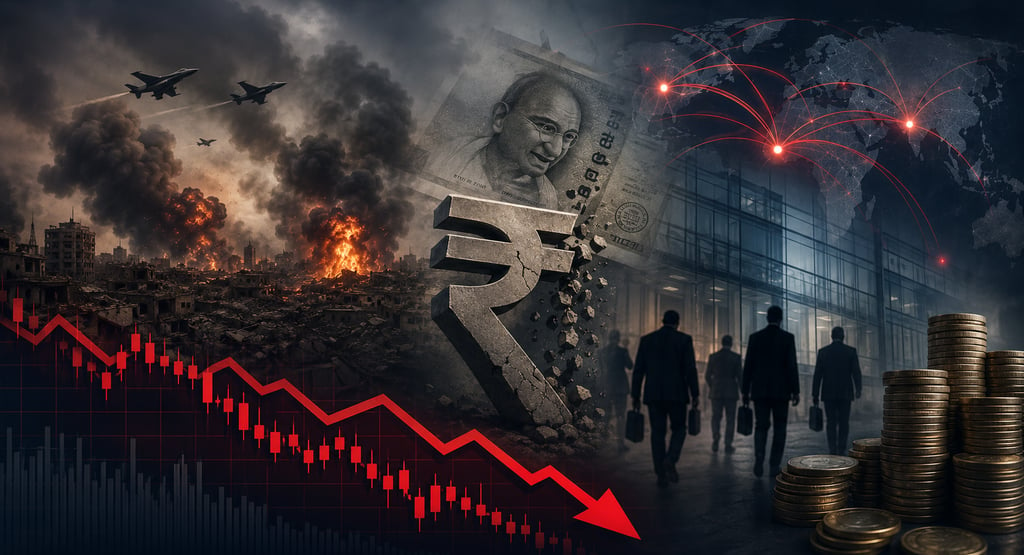
Oil prices are rising as a result of the Middle East war. The majority of our oil is now imported by India. Our import expenses increase when oil prices rise, weakening our rupee and raising the cost of doing business.
This worry caused the Indian markets to fall on March 2, 2026. The Sensex hit a six-month low, while the Nifty hit a one-month low. According to Bloomberg experts, the Nifty may possibly drop below 24,500 if this conflict continues.
Petrochemical manufacturers, oil corporations, and engineering firms like Larsen & Toubro, which has numerous projects in the Middle East, were severely impacted.
Rupee is Falling
Foreign investors return their money to their home nations after selling Indian stocks. They trade rupees for dollars, which weakens our rupee and raises demand for dollars.
The cost of importing goods like machinery, electronics, and oil increases when the rupee weakens. This increases inflation and can be harmful to our economy.
Foreign Investors are Leaving (FII Outflow)
In 2026, FIIs are heavily sell Indian stocks because of concerns about a worldwide recession, fluctuations in US interest rates, and geopolitical unrest.
This selling increases market volatility, puts pressure on our primary indices (Nifty and Sensex), and also depreciates the currency.
In particular, the Middle East crisis caused FIIs to migrate from India to energy-rich economies in anticipation of increased volatility.
What Experts Say About the Future?
Short-Term Projection
The Indian stock market will likely continue to face volatility due to global tensions still being a major problem, the value of the rupee still decreasing and foreign investors still selling the stock.
Long-Term Projection
As the historical data shows, the Indian stock market always recovers after the correction. Think about Covid times when not only the Indian stock market but also the whole world's market saw the significant decline. Then, at that time, many believed that the stock market would never recover, but we all know after the situation got better the Indian stock market not only recovered but also made new all-time highs. Similarly, in the Russia-Ukraine war, when the Indian stock market loses lakhs of crores in valuation, it still recovers and continues to rise.
Which Sectors Can Do Well and Don't Do Well
Sectors Under Pressure
Oil Refiners & Petrochemicals: Directly hurt by higher crude prices
Engineering/Construction: Companies with Middle East orders like Larsen & Toubro and KEC International fell 7–12%
Import-Heavy Industries: Electronics, automotive, and companies using imported raw materials will face cost pressure from weak rupee
Sectors Can Do Well
Domestic Companies: Businesses selling to Indian customers (not exports) will be less affected
Banking & Finance: Strong SIP inflows continue supporting these sectors
Infrastructure: Government spending keeps this sector growing
What an Investor Should Do?
For Long-Term Investors
There is no need to worry about anything; instead, you should grab the opportunity to buy fundamentally strong stocks at a cheaper price.
Invest in a sector which has future growth potential, like renewable energy, data centres, electric vehicles, and pharmaceuticals.
For Short-Term Investors
In the short term, the market can show the volatility which eventually results in losses.
Avoid investing in risky sectors like Oil and gas because they are highly impacted by the war.
Follow us on


Smart Money Management is a finance platform dedicated to helping people make smarter decisions about earning, investing, and managing money.
Quick Links
Contact Us

smm@smartmoneymanagement.site
© 2026 Smart Money Management. All Rights Reserved