
Trade Unions' Opposition and Concerns
The new labour codes in India simplify old laws to improve wages, safety, and social security for workers. While the government says they protect workers and modernise rules, trade unions oppose them, calling the codes unfair and harmful, and have planned protests.
MARKET NEWS
11/23/20251 min read

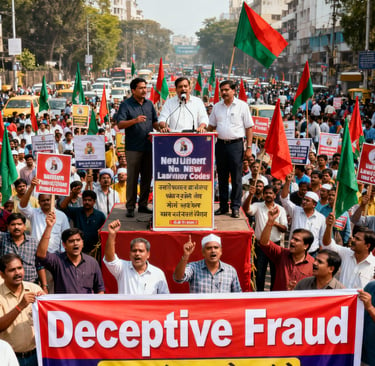
A coalition of ten major trade unions has strongly denounced the Indian government's new labour regulations as a "deceptive fraud" against workers. These codes went into effect on November 21, 2025, combining 29 labour laws into four distinct codes: the Occupational Safety, Health, and Working Conditions Code, the Industrial Relations Code, the Code on Wages, and the Code on Social Security. The unions strongly oppose the reforms as being anti-worker and pro-employer, despite the government's claims that they simplify rules, make doing business easier, and strengthen worker rights like social security and minimum salaries.
Trade unions say that the implementation was unfair and arbitrary because it didn't take into account major resistance. They draw attention to issues, including increased manufacturing hours and night work for women, especially those from lower-middle-class backgrounds, without assurances of safety. Additionally, they oppose clauses that make it simpler for businesses to hire and fire workers and raise the threshold for previous government clearance on layoffs from 100 to 300 workers, which they claim undermines workers' rights and job security. The unions caution that these laws represent a return to "genocidal attacks" on workers' livelihoods and exploitative "master-servant" interactions.
On November 26, 2025, trade unions, including INTUC, AITUC, CITU, and others, have called for a nationwide demonstration against the new labour laws. They have promised to keep fighting until these laws are repealed. The unions also stress that rather than defending workers' rights, the labour ministry's role has changed to facilitate employment.
Citing advantages including increased productivity and job growth, certain trade associations and pro-government unions have applauded the changes. Small and medium-sized businesses, meanwhile, are worried about rising operating expenses and the requirement for transitional assistance.
Follow us on


Smart Money Management is a finance platform dedicated to helping people make smarter decisions about earning, investing, and managing money.
Quick Links
Contact Us

smm@smartmoneymanagement.site
© 2026 Smart Money Management. All Rights Reserved