
Union budget negatively impact stock market, what's next?
India's 2026 Union Budget triggered a 1,500+ point Sensex drop and 2% Nifty fall due to higher STT on derivatives, hurting traders and brokers.
MARKET NEWS
Harsh Garg
2/2/20262 min read
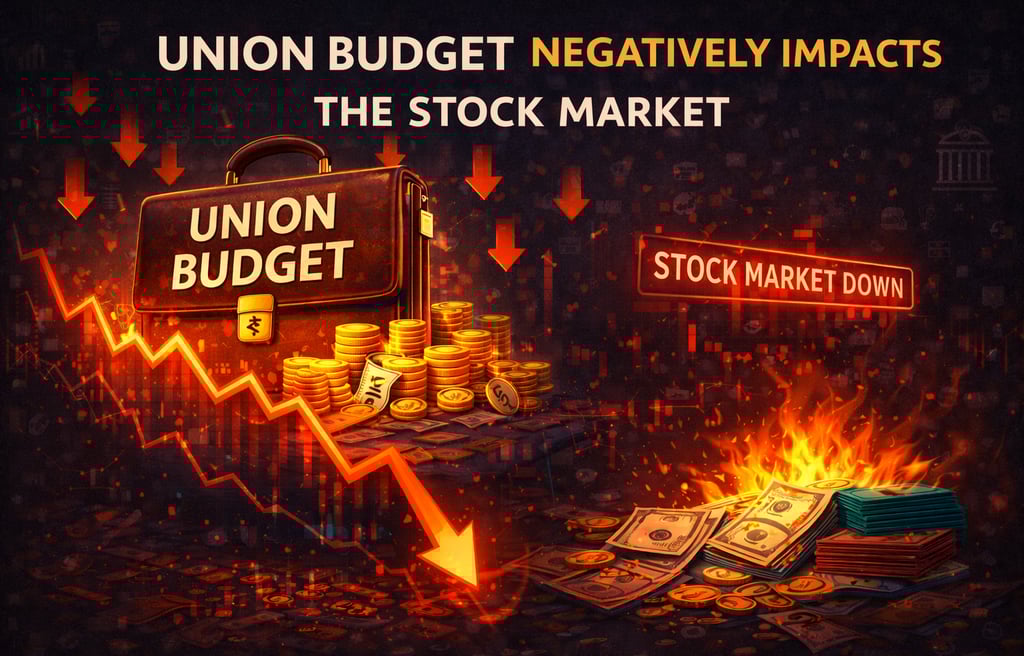
India's Union Budget 2026, announced on 1 February 2026, generated a dramatic negative reaction in the stock market due to a significant rise in the Securities Transaction Tax (STT) on derivatives trading. The Sensex lost more than 1,500 points, and the Nifty closed more than 2% lower, marking one of the worst Budget Day performances in years. This essay investigates the causes and predicts what investors might expect next.
Budget Measures Sparking Sell-Off
The main culprit was the STT hike, which went from 0.02% to 0.05% on futures trades and 0.15% on option premiums and exercises (up from 0.1% and 0.125%). It hiked trading expenses to reduce speculation and increase income, which hurt high-volume F&O segments. Brokerage and capital market companies like as MCX, Angel One, and BSE, fell between 8 and 18%, while PSU banks fell due to merger worries raised by a new banking review committee.
Immediate Market Impact
Benchmark indices moved dramatically during the special Budget session, wiping out early gains as profit-taking increased. The Nifty dipped below 25,000, with derivatives-heavy traders and leveraged players leaving holdings amid concerns about weaker volumes. Defensive sectors fared better, although overall volatility dampened the mood on Dalal Street.
Positive Budget Highlights
Despite the negative, the budget prioritised growth by increasing public capex to ₹17.1 lakh crore, focusing on infrastructure through InVITs, REITs, and corridors like Purvodaya. Manufacturing has received tax incentives for non-residents in bonded zones, MSME grants of ₹10,000 crore, and schemes for semiconductors and textiles. Energy security initiatives include a ₹20,000 crore CCUS outlay and nuclear exemptions until 2035, indicating a long-term capital spending trajectory.
What's Next? Recovery Outlook
Markets frequently recover from post-Budget volatility as attention moves to positives such as fiscal discipline (deficit at 4.3% of GDP) and a 7% growth target. Analysts predict short-term consolidation but long-term growth from infrastructure, manufacturing, and EVs, with HCL Tech, M&M, and Delhivery as their preferred companies. If global cues (US rates, earnings) support, the Nifty could settle around 24,800-25,400, with FII flows crucial given the high valuations. For investors, this dip provides an opportunity to invest in budget beneficiaries while avoiding F&O speculation in the medium term.
Follow us on


Smart Money Management is a finance platform dedicated to helping people make smarter decisions about earning, investing, and managing money.
Quick Links
Contact Us

smm@smartmoneymanagement.site
© 2026 Smart Money Management. All Rights Reserved