
Why Many People in India are Poor but Few are Rich?
This blog will explain you what are those reasons which make India a very unequal country where some people have so much money but majority people are struggle to fulfill their daily expenses.
BLOG
Harsh Garg
6/22/20262 min read
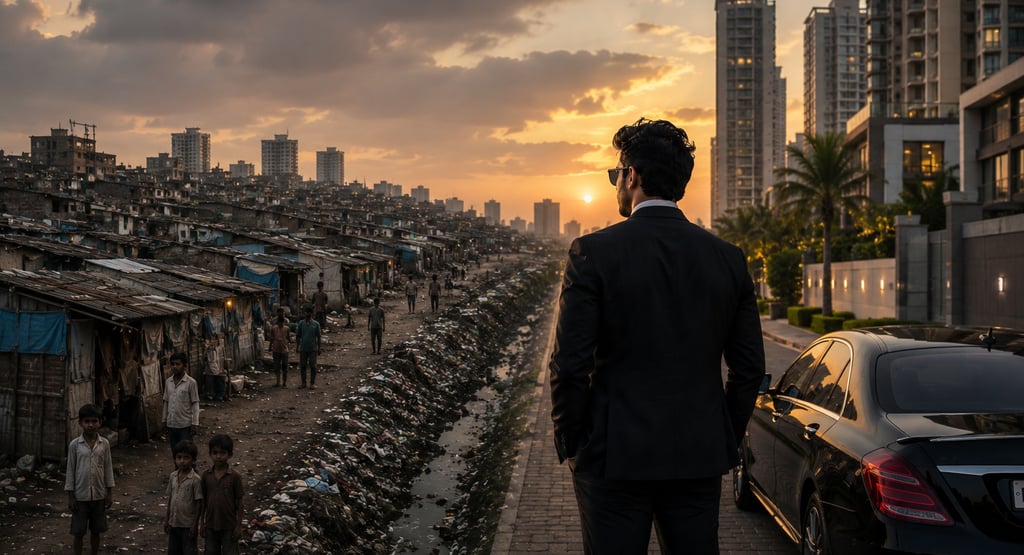

Due to the extremely unequal distribution of opportunities, assets, and income, many Indians live in poverty while a small percentage are wealthy. India has experienced rapid progress, but not everyone has benefited equally. While a sizable portion of the population continues to rely on low-paying, uncertain jobs, a small fraction controls the majority of the wealth.
Why are so many still poor?
Less income from farming
Many farmers in India have small fields, and more than half of the country's agriculture is rainfed. Low output and low income follow from this. Approximately 45% of workers are employed in agriculture, which contributes just 14–16% of GDP, meaning that many people work for very little money.
Too many people but not many good jobs
Every year, India adds over 17 million new residents. This makes it challenging to offer enough high-quality hospitals, schools, and jobs. Poverty rates are particularly high in places like Uttar Pradesh and Bihar that are experiencing rapid population expansion.
Weak education and skills
Many kids receive poor education or training. People cannot work in well-paying occupations in factories, offices, or technology if they lack the necessary abilities. Because of this, they are forced to labor in low-paying, unstable jobs.
Rural-urban gap
Cities have better businesses, hospitals, schools, power, and roads. These are rarely found from rural areas. Thus, there are fewer opportunities for growth for people living in villages. One of the primary causes of inequality in India is the gap between rural and urban areas.
Social barrier
Access to land, education, and employment is still influenced by caste, gender, and family history. Due to these obstacles, the poverty rates of marginalised groups, such as Scheduled Castes and Scheduled Tribes, are significantly higher than the national average.
Inflation and low savings
Poor families suffer more when food, fuel, and medication prices rise since their income does not increase accordingly. They can't save or invest to better their future because they have little money left over after basic necessities.
Why only few are rich?
Concentration of wealth
Approximately 77% of India's wealth is held by the richest 10% of its citizens. Large companies, real estate, and investments that increase their income more quickly than others are available to this small group.
Better access to opportunities
Wealthy families can afford networks, quality schools, coaching, and medical care. Their kids can easily launch their own companies or get high-paying jobs. As a result, wealth is concentrated in a small number of families.
Policies and tax issues
Large corporations and wealthy people benefit more from certain government policies and tax regulations. Additionally, a lot of wealthy people avoid paying their fair share of taxes. This limits the amount of money the government can spend on jobs for the underprivileged, hospitals, and schools.
Capital-heavy growth
Modern Indian companies usually use more machines than labourers. Ordinary people will have fewer jobs as a result, while owners and investors will receive a larger portion of the earnings. Thus, growth benefits the wealthy more than the typical worker.
Simple ways to understand
Imagine if India is a large pizza. The pizza has become larger throughout time due to the nation's expansion. However, the issue is that a tiny number of people eat the majority of the additional slices.
Only a few tiny bits must be shared by the others. Many people are still disadvantaged as a result.
Follow us on


Smart Money Management is a finance platform dedicated to helping people make smarter decisions about earning, investing, and managing money.
Quick Links
Contact Us

smm@smartmoneymanagement.site
© 2026 Smart Money Management. All Rights Reserved